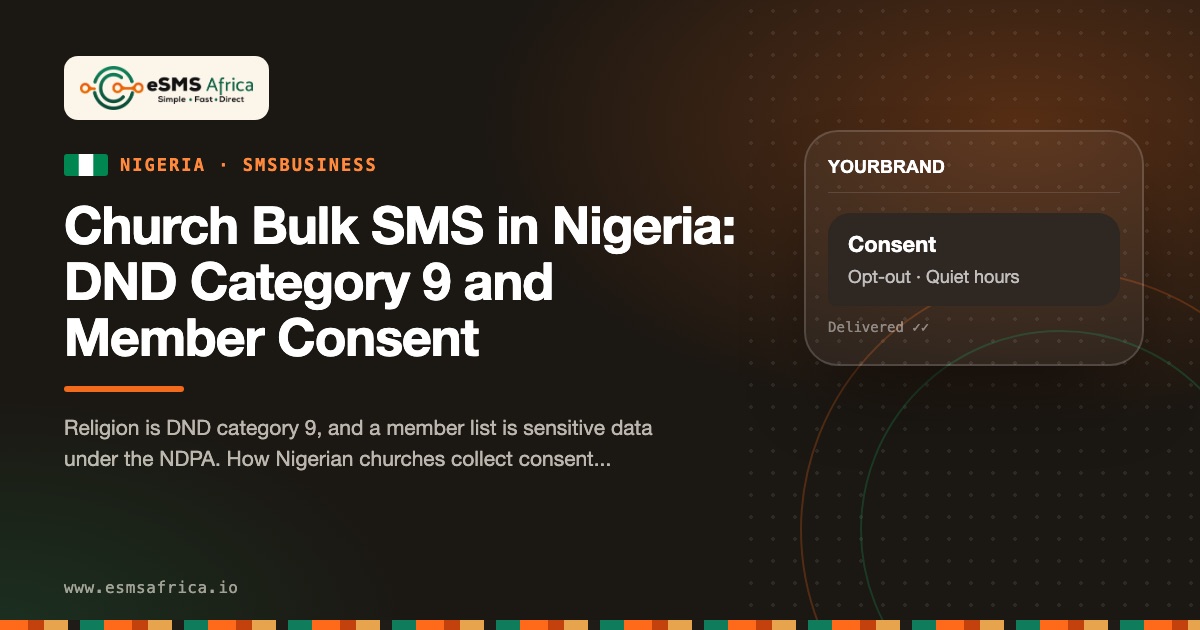
Churches in Nigeria can send bulk SMS to their members, but two rules shape how. Under the NCC's Do-Not-Disturb service, religion is partial DND category 9, so members on full DND, or on partial DND without category 9, may not receive church messages sent as ordinary bulk traffic. Under the Nigeria Data Protection Act 2023, a church's member list reveals religious belief, which is sensitive personal data, so the safest basis for messaging is clear, recorded consent from each member, with an easy way to stop.
Last reviewed: 27 October 2026
This guide is for church administrators, media teams and parish secretaries. It covers what DND means for church messages, how to collect consent that holds up, what to send and how often, sample templates, and how to send with eSMS Africa. It is practical guidance, not legal advice.
What DND means for church messages
The Nigerian Communications Commission requires every network to run DND on short code 2442. A subscriber who texts STOP to 2442 activates full DND and should stop receiving unsolicited messages. A subscriber who texts HELP can set partial DND and choose categories to keep receiving. The NCC lists 11 categories, and category 9 is religion. A member can keep receiving religious messages by texting 9 to 2442, and ALLOW removes DND altogether.
Networks apply DND to promotional (bulk) traffic. Church announcements, event invitations and programme reminders are usually treated as bulk traffic, so they are subject to DND. Transactional routes, which typically reach DND numbers, are intended for messages such as OTPs and alerts, not for congregation announcements. This split is operator practice; our article on bulk SMS to DND numbers in Nigeria explains what reaches DND subscribers.
What this means in practice:
- Some members who gave you their number will not get your messages because they are on full DND. That is their network setting, and you should not try to route around it.
- When a member says "I never get the church SMS", show them how to check with STATUS to 2442 and, if they want your messages, how to allow category 9.
- Delivery reports help you spot these members. A number that never delivers is worth a quiet word at the next service.
Consent: why it matters more for churches
The Nigeria Data Protection Act 2023 (NDPA) treats data revealing religious or similar beliefs as sensitive personal data, which can only be processed under specific conditions, consent being one of them, according to the Future of Privacy Forum's summary of the Act. A list of phone numbers labelled "Grace Centre members" reveals religious belief. The Act also requires consent to be freely given, specific, informed and unambiguous: pre-ticked boxes and silence do not count.
Section 36 gives every data subject the right to object to processing, and Templars notes that the right to opt out of direct marketing cannot be overridden. A member who asks to stop receiving messages must be removed promptly.
A simple consent process that works for most churches:
- Collect numbers on a membership or first-timer card with a separate line: "I agree to receive SMS from Grace Centre about services, events and church news. I can stop at any time." The member ticks it themselves.
- Record the consent in your contact list: date, how it was collected (card, online form, usher), and which groups the member joined.
- Send a welcome message that says who you are and how to stop.
- Honour stop requests the same day. Add the number to the dashboard opt-out list so no future campaign reaches it.
- Never share the list with other ministries, event promoters or political campaigns, and never buy lists.
What to send, and how often
Members value messages that save them a phone call. They tire of daily devotionals they did not ask for. A pattern that most congregations accept:
| Message | When | Who |
|---|---|---|
| Sunday or midweek service reminder | Day before, daytime | All consenting members |
| Cell or house fellowship reminder | Morning of the meeting | That group only |
| Special programmes: vigil, convention, crusade | One week and one day before | All consenting members |
| Venue or time change | As soon as decided | Affected members |
| Giving acknowledgement (bank transfer received) | After reconciliation | The giver only |
| Welfare: condolence, hospital visit, wedding | As needed, with the family's permission | Relevant group |
The NCC's consumer pages do not set a time-of-day rule for SMS. Vendors often cite an 8am to 8pm window for promotional traffic; treat that as operator practice and a sensible courtesy rather than law. Weekday evenings after work and Saturday mornings tend to suit reminders.
Sample messages
Each sample names the church, stays under 160 characters and avoids the naira sign, which would switch the message to Unicode and cut it to 70 characters per segment.
| Purpose | Sample |
|---|---|
| Welcome | Welcome to Grace Centre, Ngozi! We will text you about services and events. To stop, tell an usher or SMS STOP to 6xxx. |
| Service reminder | Grace Centre: Sunday service starts 8am at Admiralty Way, Lekki. Thanksgiving Sunday - come with your family! |
| Cell group | Grace Centre: Hello Emeka, Ajah cell meets Wed 6pm at the church annex. See you there! |
| Programme | Grace Centre: Holy Ghost Night is Fri 15 Nov, 10pm to 4am. Free shuttle from Ajah and VI from 9pm. Invite a friend. |
| Change notice | Grace Centre: Due to road works, Saturday choir rehearsal moves to 4pm in Hall B. Sorry for the change. |
| Giving receipt | Grace Centre: We received your transfer of NGN20,000 (building fund) on 27/10. Thank you and God bless. Ref GC1027-114 |
For giving receipts, do not include the member's account number, and send only to the giver. Many Nigerian congregations give by bank transfer to the church account or by USSD, and finance teams reconcile weekly; a receipt sent after reconciliation avoids acknowledging transfers that later reverse.
Sender ID and opt-out
Nigerian networks approve sender IDs one by one. A church usually applies with its registration documents from the Corporate Affairs Commission and a letter on letterhead. Pick a name members recognise, up to 11 characters, such as "GraceCtr". eSMS Africa handles the submissions; steps and fees are on the Nigeria sender ID page. While approval is pending you can test on the eSMS default sender.
A one-way sender ID cannot receive replies, so do not write "reply STOP" on it. Give members a real way to stop: tell an usher, call the church office, or text STOP to a two-way number. Two-way short codes can be ordered online in Nigeria; STOP replies on a two-way number are recorded as opt-outs automatically. See two-way SMS for details.
Sending with eSMS Africa
In the dashboard at sms.esmsafrica.io you can import members from a CSV or Excel sheet, keep groups (choir, ushers, youth, each cell), write templates with merge fields such as the member's name, and schedule messages. Sends to numbers on your opt-out list are blocked automatically. Campaign approvals and team roles let the media team draft while the administrator approves.
If your membership system can call an API, the bulk endpoint personalises each message:
curl -X POST https://sms.esmsafrica.io/api/messages/send-bulk \
  -H "Authorization: Bearer esms_live_your_api_key" \
  -H "Content-Type: application/json" \
  -d '{
    "sender_id": "GraceCtr",
    "text": "Grace Centre: Hello {{name}}, your {{group}} cell meets Wed 6pm at {{venue}}. See you there!",
    "recipients": [
      {"to": "+2348031234567", "name": "Ngozi", "vars": {"group": "Lekki 2", "venue": "Bro. Tunde's house"}},
      {"to": "+2348051234567", "name": "Emeka", "vars": {"group": "Ajah", "venue": "the church annex"}}
    ]
  }'
Checklist
- Consent line on every membership card and online form, not pre-ticked.
- Consent date and source recorded for each number.
- Welcome message that names the church and explains how to stop.
- Stop requests honoured the same day and added to the opt-out list.
- Messages sent to the right group, in daytime, and no more often than members find useful.
- Sender ID approved on MTN, Airtel, Glo and T2.
- List never shared, sold or used for anything members did not agree to.
What it costs
Messages are billed per SMS segment at the Nigeria rate: NGN 9.1 ($0.0068) on the basic tier. A church of 800 consenting members sending two reminders a week sends about 6,400 messages a month, so keeping every message to one segment matters. See the pricing page for tiers.
Frequently asked questions
Why do some members not receive our church SMS?
The most common reason is DND. A member on full DND, or on partial DND without category 9 (religion), may not receive bulk messages. They can check with STATUS to 2442 and allow religious messages by texting 9 to 2442.
Can we send church messages on the transactional route to reach DND numbers?
No. Transactional routes are for OTPs, alerts and receipts. Announcements and invitations are bulk traffic, and sending them as transactional risks the sender ID being blocked.
Do we really need consent if members gave us their numbers?
A member list reveals religious belief, which the NDPA treats as sensitive. A clear, recorded consent line on the card you already use is the simplest way to show the member agreed to receive SMS.
Can we share our list with a sister church for a joint programme?
Not without the members' consent for that purpose. Send the invitation yourself to your own consenting members instead.
Sources
- NCC - Do-Not-Disturb (DND) service in Nigeria
- NCC - Rules on unsolicited calls and SMS
- Future of Privacy Forum - Nigeria's new Data Protection Act, explained
- Templars - Unsolicited messaging and the limits of opt-out provisions
See more church and event templates on the churches and events SMS page for Nigeria, compare with our weekly church SMS plan for Kenya, or read about choosing a bulk SMS provider in Lagos and Abuja. Create a free account to import your members and send a test.